Events
The structured event stream, every event name, and the ledger projected from it.
One JSON line per event to stdout. The dashboard, the audit command and the owner's ledger are all views over this stream.
Shape
{ "ts": "2026-07-07T18:21:27Z", "event": "need_info.terms_dictated",
  "corr": "fam_8f3a…", "actor": "uma-as",
  "details": { "tier": "tier1", "template_id": "alice/advisor-tier1/v2",
"resource_id": "alice-vault/get_positions" } }| Field | Meaning |
|---|---|
ts |
UTC, RFC 3339 |
event |
Dotted name from the register below |
corr |
The negotiation family id, stable across every ticket rotation |
actor |
Which component emitted it |
details |
Event-specific, and deliberately free-form |
corr is the field that makes this usable. With a replicated authority, a single
negotiation's events are spread across every instance, so reading one pod's logs
shows a fragment. Correlate by family, not by process.
Event register
Registration and discovery
| Event | Emitted when |
|---|---|
terms.published |
A terms document version is published |
terms.declined |
The requesting side refuses the proffered terms |
The negotiation
| Event | Emitted when |
|---|---|
permission.registered |
POST /perm issues a ticket |
challenge.issued |
The enforcement point refuses with a challenge |
ticket.presented |
The agent presents a ticket at the token endpoint |
need_info.terms_dictated |
The authority proffers terms |
contract.committed |
A signed agreement verifies |
contract.rejected |
An agreement fails verification |
assurance.assessed |
What her authority could verify about the agent asking |
operator_directory.checked |
An operator's key directory was fetched and searched for this agent's key |
operator_directory.rejected |
A directory was named that is not same-origin with the operator claimed |
operator_directory.unresolved |
A directory would not resolve; the claim stays where it was |
policy.evaluated |
A tier policy decision is made. result includes attention-budget when a lane is full and operator-blocked when she has shut that operator out |
The owner
| Event | Emitted when |
|---|---|
ticket.awaiting_owner |
The negotiation is held pending her decision |
owner.notified |
The pending item reaches her surface |
owner.decision |
She approves or denies |
connection.approved |
A standing relationship is recorded |
connection.introduced |
An agent is admitted on another agent's introduction, without a first-contact question |
connection.introduction_refused |
An introduction did not apply; the agent falls back to first contact, and the reason is recorded |
connection.revoked |
She revokes one |
policy.updated |
She edits a tier |
policy.created |
She adds terms of her own |
policy.deleted |
She removes a tier; its resources become ungoverned |
operator.blocked |
She shuts out an operator, with the connections and grants it cost |
operator.unblocked |
She lets one ask again |
The grant and its use
| Event | Emitted when |
|---|---|
rpt.issued |
A grant is minted |
receipt.issued |
The counter-signed receipt is returned |
rpt.introspected |
The enforcement point checks a grant |
rpt.consumed |
A single-use grant is spent |
access.allowed |
A call reaches the resource |
access.denied |
A call is refused |
A resource server meeting an authority
| Event | Emitted when |
|---|---|
resource_server.registered |
One introduces itself. Carries the status it landed in, and the one it was in before |
resource_server.revoked |
She withdraws it |
resource_server.registration_refused |
The signature was not from a key that origin publishes |
resource_server.metadata_rejected |
The document resolved and did not check out — it claimed another resource, named another authority, or pointed its keys elsewhere. The reasons are in the event |
Every other event
Emitted beside the ones above, listed by the component that emits them. Names
are stable; the details of each are what the emitting code puts there.
kwaai/ability: authority.unreachable, decision.moot, decision.unsent
lib: challenge.awaiting_owner, joint.jwks_unreachable, joint.mandate_unreadable, org.membership_unreadable, permission.mint_failed, resource_server.establish
services/joint-tally: access.reported, mandates.loaded, quote.none, quote.unreachable, ticket.awaiting_holders, ticket.minted, verdict.other_mandate, verdict.pending, verdict.recorded, verdict.refused_to_answer, verdict.unreachable, verdict.unverifiable, verdict.unverified
services/org-authority: break_glass.granted, break_glass.opened, break_glass.replay_refused, break_glass.spent, break_glass.used, break_glass.voided, charter.published, engine.loaded, engine.reloaded, engine.unreachable, engine.waiting, invitation.declined, invitation.sent, invitation.withdrawn, invoker_directory.unresolved, join_code.rotated, member.administered, member.compliance, member.joined, member.left, member.notified, member.removed, member.role_set, notice.failed, role.default_set, role.removed, role.saved
services/uma-as: client_metadata.resolved, client_metadata.unresolved, identity.asserted, identity.rejected, joint.fold_rejected, joint.joined, joint.left, joint.mandate_moved, joint.pending, joint.quoted, joint.verdict, need_info.identity_required, operator.claimed, operator.disclaimed, org.agent_blocked, org.charter_changed, org.clamped, org.client_stale, org.invitation_declined, org.invitation_unreadable, org.joined, org.membership_ended, org.notice, org.operator_blocked, org.record_unusable, org.unreachable, pat.issued, permission.rejected, resources.pull_failed, resources.pull_retry, resources.pulled, resources.unshared, resources.unshared_skipped, rpt.consume_refused
services/uma-pep: mandate.unreachable, owner_resources.denied, owner_resources.served, registration.declarative, upstream.unreachable
services/xaa-broker: connection.configured, connection.seeded, connection.withdrawn, exchange.issued, exchange.refused
The ledger, as a projection
The owner's ledger is not a separate record. It is this stream, grouped by family:
| Ledger column | Source event |
|---|---|
| promised | contract.committed |
| personally approved / denied | owner.decision |
| touched | access.allowed |
| connected | connection.approved |
| revoked | connection.revoked, and operator.blocked for every connection it ended |
| relaxed | a rule she wrote lowered an ask-me tier to automatic, naming the rule that fired |
Those first three columns answer the question she will actually ask: did what
happened match what I agreed to. Reading them side by side is the point —
promised without a matching touched is a grant that went unused, and
touched without a matching owner.decision is either a tier she opened
deliberately or something to investigate.
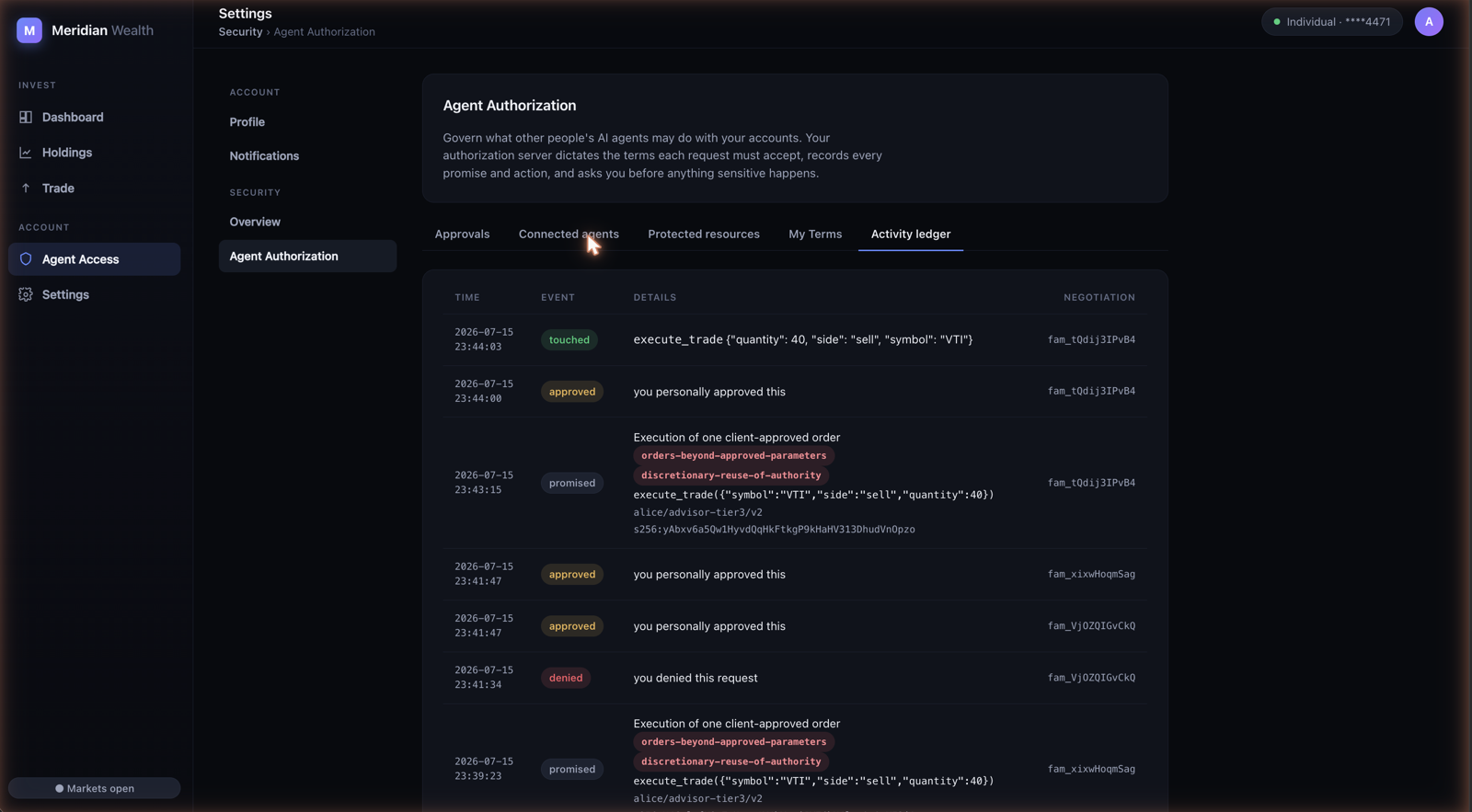
The rightmost column is the negotiation family. Three rows of a single story sit apart in time and are joined by that id, which is what makes the ledger answerable rather than merely chronological.
The row, and every kind of entry
The projection above is the part of the ledger her portal puts in front of her. It is not all of it. The table holds one row per entry, append-only — nothing here is ever updated or deleted, which is what makes a later reading of it worth anything:
| Field | Meaning |
|---|---|
seq |
Insertion order, and the only total order there is |
owner |
Whose ledger this row belongs to. Every read is partitioned by it |
kind |
Which of the entries below this is |
family |
The negotiation this belongs to, or - for something outside one |
ts |
When it was written, in UTC |
handle |
The agent it is about. A column rather than a field inside entry, so one agent's whole trajectory is an index lookup. NULL where there is no agent — a resource server's registration being revoked, or a decision taken before an agent was named |
entry |
The rest, as JSON. Its shape depends on the kind |
The kinds written, grouped by what they are about:
The grant loop
| Kind | Written when | entry carries |
|---|---|---|
promised |
An agent signs her terms and the contract is accepted | the tier, purpose, prohibited actions, expiry, agreement hash, terms URI, and the proposed operation, stated reason and cited mission where the contract carried them; consequence where the resource declared what the act leaves behind, and clearance — the facts somebody else attested — where her policy required one |
approved / denied |
She answers a pend | the tier, and by when an organization administrator answered instead of her |
connected |
An agent becomes a standing connection | its identity, and introduced_by when another agent put it forward |
touched |
A call is actually allowed at the resource | what was reached |
relaxed |
A rule she wrote lowered a requirement | the rule that fired |
refused |
Her policy, a blocked operator, or the attention budget ended it | the tier and the reasons |
identity_refused |
The agent's credential did not verify | why |
revoked |
A connection, an operator or a resource server registration is withdrawn | rpts_deactivated, plus connections_revoked for a cascade, the operator for an operator block, and by for an administrator |
Her operators
| Kind | Written when | entry carries |
|---|---|---|
claimed / disclaimed |
She names an origin as hers, or stops | the origin |
An organization she belongs to
| Kind | Written when | entry carries |
|---|---|---|
org_joined / org_left |
She joins or leaves | the organization and the charter version she agreed to |
org_declined |
She was offered a role and did not take it | the organization |
org_role |
Her role changes | the role |
org_clamped |
The charter tightened terms she had written | which of her fields moved |
org_acted |
An administrator acted on her behalf | what, and which administrator |
org_refused |
The charter refused a request her own policy would have allowed | the reasons, organization and charter version |
break_glass |
An administrator used the emergency path | the justification, and stage — break_glass_opened, break_glass or break_glass_used. All three share one family, the override's id; each notice carries its own jti, which is what stops the second being read as a replay of the first |
A resource she holds with somebody else
| Kind | Written when | entry carries |
|---|---|---|
joint_joined / joint_left |
She joins or leaves a jointly held account | the account |
joint_moved |
The tally publishes a mandate that differs from the one she agreed to. Her authority signs nothing for the account until she agrees again | the account, and what changed in her words |
joint_allowed / joint_refused |
Her half of a joint decision | the account, the resource, and the reasons for a refusal |
The kinds that are refusals are worth naming as a set: refused,
org_refused, joint_refused and identity_refused. A record that only shows
what was allowed cannot answer the question people actually bring to it.
Reading it in the lab
make k8s-auditPrints the three columns correlated by family. The compose equivalent is
make audit.
Reading pod logs directly will mislead you when the authority is replicated. Ship the stream and query it, or use the audit command, which reads the store rather than a process.
Emitting your own
Two properties matter more than the schema:
Assign the correlation id once, when the permission is registered, and carry it through every rotation. An id regenerated per presentation makes the stream unjoinable, which is the failure mode that looks fine until the first time somebody needs an answer.
Emit refusals as loudly as successes. access.denied and
contract.rejected are the events that tell you the system is working. A stream
with only the happy path cannot distinguish a healthy deployment from one where
enforcement is switched off.