Revocation and the ledger
What was promised, what was approved, what was touched — and what happens the moment the owner changes her mind.
A standing connection, and the live grants issued under it. This is what Alice sees: a relationship with one agent, not a list of tokens.
- A standing connection, and the live grants issued under it. This is what Alice sees: a relationship with one agent, not a list of tokens.
- She revokes it. Ending the relationship and burning every grant behind it happen in one operation — as two steps the second can fail on its own, leaving the agent holding exactly the authority she just withdrew.
- An agent presenting one of them is told so explicitly, and the answer is terminal. Re-negotiating cannot change an outcome she has already settled, and a bare inactive would send it round the loop again.
Consent that cannot be withdrawn is not consent, and an approval nobody can reconstruct afterwards is not much of a record. Those two requirements produce the same machinery.
One event stream
Every step of a negotiation emits a structured event: the challenge, the terms dictated, the contract committed, the owner notified, her decision, the grant issued, the call allowed or denied, the connection revoked.
Every event carries the same correlation id — the negotiation family, assigned when the ticket is created and stable across every rotation of it. One negotiation, one thread, however many messages it took.
The ledger is a projection
The ledger is not a separate store. It is a view over that stream:
- promised — the contracts committed, with the hash of the terms signed
- approved / denied — the owner's own decisions
- touched — the calls actually allowed
- revoked — connections ended
Keeping it a projection rather than a table means the audit trail cannot disagree with what happened. There is no second write to forget.
Refusals are recorded too. A denial is a decision, and a log that only contains successes cannot answer the question anyone actually asks after an incident.
Revocation has to be atomic
Revoking a connection does two things: it ends the relationship, and it burns every live grant issued under it.
Doing those as two steps is a bug, and it was one here. The connection flipped, and the grants were burned in a second operation that could fail independently — leaving the agent holding exactly the authority the owner had just withdrawn, with the interface telling her it was gone.
The fix is the same lesson as single-use: one operation that decides and records together. Revocation ends the connection and burns its grants indivisibly, or it does neither.
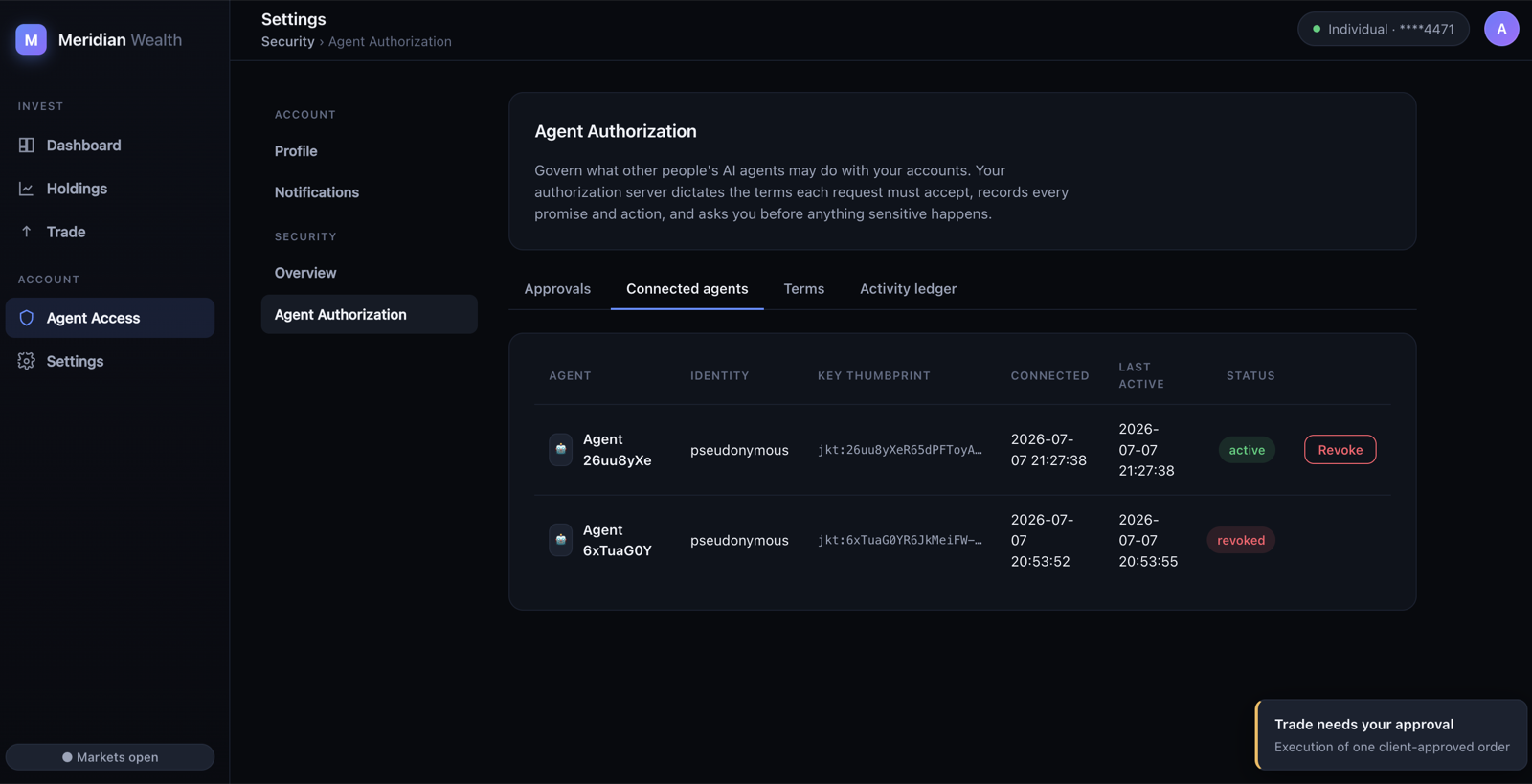
What she is revoking is the relationship, not a token. The agent above is named by the thumbprint of its key, because a pseudonymous agent is its key — and the row stays after revocation, because the fact that she once connected to it is part of the record.
Revoking an operator, not an agent
Revoking is per agent, and one at a time is not an answer to a flood.
So the same action exists a level up: block the operator an agent names, and every agent it runs is shut out at once, with whatever is already connected revoked in the same step. A block that stopped new requests and left live grants alone would leave her believing she had closed a door that was still open — the same indivisibility the section above is about.
This is what makes the attention lanes worth having. Their job is to ensure a flood large enough to matter arrives attributable, and an attributable flood is one she can end here in a single action.
Blocking is a restriction, so it can rest on what the agent claims about itself with none of the usual care: an agent that lies about its operator only ever lies itself into a refusal.
Two limits, stated rather than glossed:
- It does not remove anyone from the internet. Drop the client identifier and the same party returns as an anonymous stranger — no accountability, the small lane, pending in front of her like anyone else.
- Unblocking is not the reverse of blocking. It restores the right to negotiate, not the access that was withdrawn. Connections the block revoked stay revoked and have to be established again.
What the agent sees
An agent presenting a revoked grant is told so explicitly, and the answer is
terminal. It is not need_info, and it is not an invitation to renegotiate.
That distinction matters more than it looks. A bare "inactive" sends a well-behaved agent back around a negotiation whose outcome is already settled, which wastes everyone's time and looks, from the owner's side, like an agent that will not take no for an answer.
Why this survives the deployment
In the replicated shape, revocation is correct because every replica reads the same store, so a revoked connection is revoked everywhere the instant it commits.
That is worth stating plainly as a boundary rather than a feature. Stretch this across regions, or across more than one authorization server, and it becomes a distributed-systems problem this profile does not itself solve. What it gives you is a revocation that is atomic within one authority, which is the part the protocol can be responsible for.
How long it actually takes
"The instant it commits" is true of the thing revocation is usually about — a connection, and the grants issued under it — and it is worth being precise about why, and about what it is not true of.
A revoked connection or grant: the next call. The enforcement point does not decide anything locally. It introspects the grant at the authority on every call, and a grant whose connection is no longer active fails there. So a revocation lands on the next call the agent makes, whenever that is, rather than at the grant's expiry. That is why a grant can last as long as her terms say it does: its expiry is when it stops by itself, not how long a withdrawal takes to reach it.
Two things the enforcement point does cache, and for how long. Both are inputs it can read without asking about a specific grant, and both are cached to keep a per-call round trip off the hot path:
| Cached | Default | Effect when it changes |
|---|---|---|
| Organization membership and role | 10s | A role change or a removal can take up to that long to bite |
| A joint account's mandate | 30s | A change to who counts, or at what weight, takes up to that long |
| An owner's authority's published keys | 300s | A key rotation is not visible until it lapses |
So an owner revoking an agent sees it stop on the agent's next call. An
administrator removing somebody from a role, or a co-owner changing a mandate,
is working against a window measured in seconds. The windows are configurable
(UMA_PEP_MEMBERSHIP_TTL_S, UMA_PEP_MANDATE_TTL_S), and the reason they exist
at all is that they only ever affect how soon a tightening applies — the grant
itself is never cached, so no cache can keep a withdrawn authority alive.