The two intents
Who decides whether an AI agent is doing what it said it would — the agent's operator, or the owner of the data it is touching. How U4A answers that, and what the owner can check for herself.
Alice writes her terms before any agent exists. They name what the access is for, what she will not have done with it, how far it reaches and for how long — and they name no agent, so they hold for whoever turns up.
- Alice writes her terms before any agent exists. They name what the access is for, what she will not have done with it, how far it reaches and for how long — and they name no agent, so they hold for whoever turns up.
- An agent turns up, signs those terms, says why it is asking, and reads what it asked for. Two rows: what it promised, and what it then did. Both are hers, on her side, whether or not anyone reports anything to her.
- It keeps going. Every row is at the same tier, which is the boring case and the one that should stay boring — what it did and what it said it wanted are the same shape.
- Then a row at a tier it has never reached. Nobody had to tell her: the widening is a fact about her own register, and a rule she wrote — ask me the first time an agent reaches somewhere new — reads exactly that.
Two parties want something out of a grant, and both of them have an intent.
Alice has decided, in advance, what she will accept being done with her things. Bob's agent has arrived wanting to do something specific, now, for a reason of its own.
Almost all current work on agent intent handles the second one and puts it on the requesting side: the agent declares a task, its own platform watches the session, and a departure is reported. That works while one party owns both the agent and the data. It stops working here, because Alice cannot see inside Bob's infrastructure and has no way to check a report that comes out of it.
She does not need one. Every request that agent ever made of her arrived at her side.
What each side puts in
Alice's half is a tier, written before any agent exists:
"tier3": {
  "name": "Trade execution",
  "resources": ["alice-vault/execute_trade"],
  "ask_me": true,
  "terms": {
    "purpose": "Execution of one client-approved order",
    "scope": ["trades:execute"],
    "expires_in": 900,
    "prohibited": ["orders-beyond-approved-parameters",
                   "discretionary-reuse-of-authority"],
    "per_operation": true
  }
}
No agent is named anywhere in it. Editing any field publishes a new version, and every version stays fetchable, so an agreement signed last month still points at terms that resolve.
The agent's half is that template signed back, plus up to three things of its own:
operation |
the exact act it proposes, on tiers that require one |
reason |
free text — why it says it is asking |
mission |
a reference to a mandate it is acting under: who approved it, and the hash of what was approved |
What her authority checks
The echo, field by field. A rewritten purpose, a dropped prohibition or a stretched expiry ends the negotiation. Binding itself to more than she asked is allowed, because that direction costs her nothing.
Her authority never reads the reason and never compares it to her purpose. That would put a judgement about natural language inside an authorization decision, and the same request would start coming out two ways.
The mission is recorded and not resolved. A mandate is served to the party that set it, so there is nothing for a relying party in another trust domain to fetch — from her side, an agent citing a real mandate and an agent inventing a hash look identical. Both the reason and the mission are therefore claims, and her policy may do one thing with either: notice it is missing.
{"when": ["request.reason_absent"], "then": "ask"}Rules like that can only add friction. Her authorization server refuses to store
them under then: auto, at the point policy is saved rather than when it runs.
Silence costs an agent something; so does a lie.
Which prohibitions can actually be refused
Not all of them. What divides the two is whether the forbidden thing has to cross her boundary to happen.
Her trade tier forbids orders beyond the approved parameters and discretionary reuse of authority. Both of those are calls. Placing such an order means invoking her tool while the enforcement point holds a digest of the parameters she approved, so it is refused. Reusing the authority means presenting a spent grant, which is refused too. Neither check was added for this — both have been running since the grant loop was built, and her terms simply never said so.
Her holdings tier forbids retention after review, marketing, and model training. Those happen on the requester's own disks after the bytes have left. Nothing reaches them.
So her published terms mark each line with the mechanism that refuses it, and say nothing where there is none:
"prohibited": ["orders-beyond-approved-parameters",
               "discretionary-reuse-of-authority"],
"enforced":   {"orders-beyond-approved-parameters": "operation-binding",
               "discretionary-reuse-of-authority": "single-use"}
The annotation is computed when the document is read, never written into it. A published version's bytes never change — that is what lets an old agreement stay checkable — and her enforcement posture can change without the terms changing at all, so it is shown alongside rather than folded in.
The half that stays unenforceable is what the dually-signed record is for. That is a weaker thing than enforcement and a stronger one than a consent checkbox.
What she can see afterwards
Everything, which is the part the requester-side framing misses.
Her register holds what each agent promised, what she decided, what it went on
to call, and which of her tiers each call was made against. One agent's history
is one query — GET /owner/ledger?handle=…, or its handle in the Connected
agents tab.
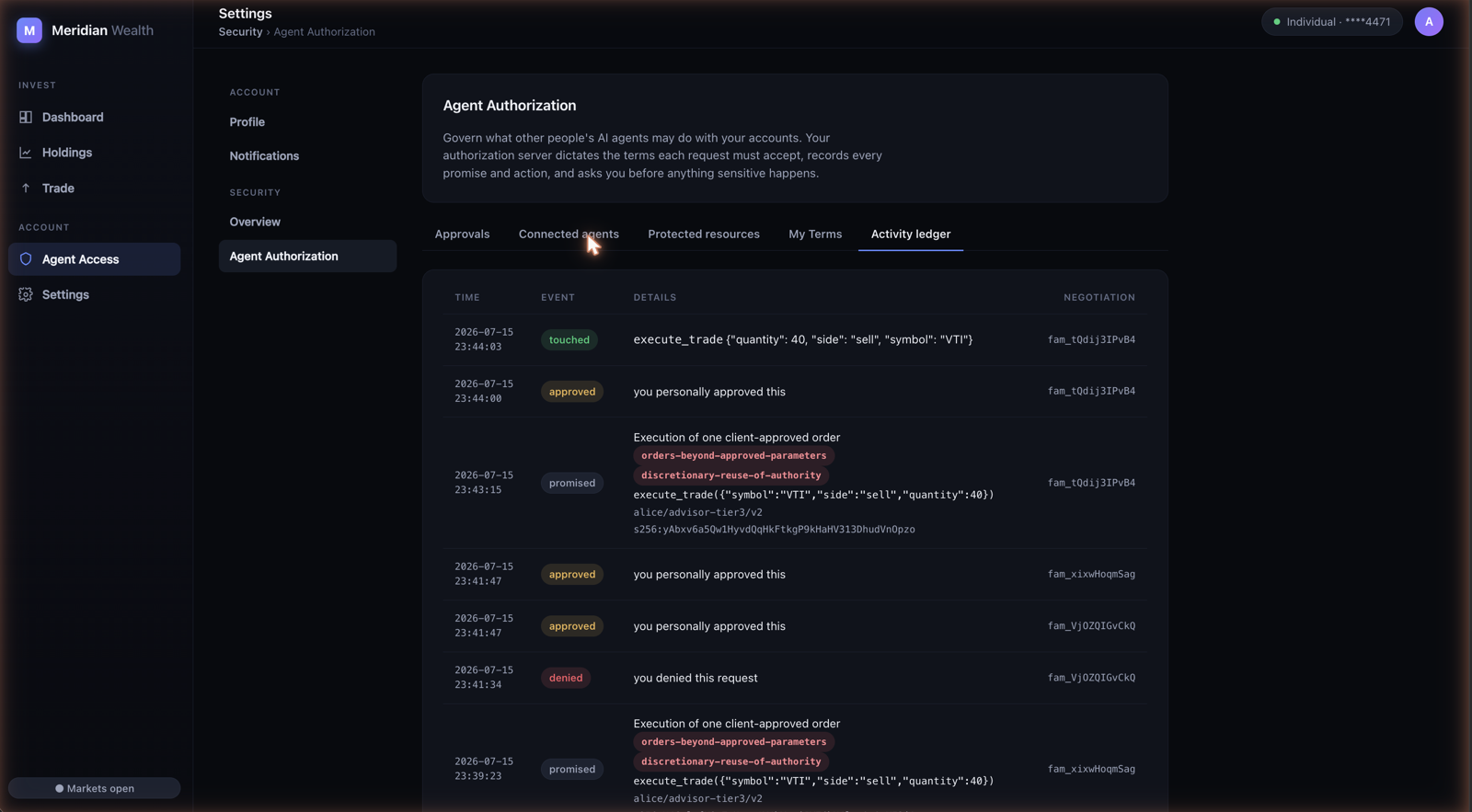
An agent admitted to read holdings that starts reaching further does not need to be reported. It looks different in her own record, and rules she writes can read that while deciding:
| Condition | What it notices |
|---|---|
standing.first_at_tier |
it is reaching somewhere new |
standing.tiers_above:<n> |
how far across her resources it has spread |
standing.calls_above:<n> |
how much it did with what it was given |
standing.denials_above:<n> |
it is asking again after she said no |
None of them name an agent, and none can be written into a relaxation.
One entry in her register can never be attributed to anyone. A decline arrives before the requesting side has signed anything, so there is no key and nothing to file it under. Her record says her terms were refused, which is true and is all that is knowable.
What this does not do
- A stated purpose is not enforceable. Recording it buys something that can be produced later, not a control.
- This authorizes calls, not sessions. A session-scoped intent checked against every tool call is a requester-side control, and it composes with this rather than being supplied by it.
- Her terms cover her resources. What an agent does elsewhere belongs to whoever operates it.
Where to go next
- Terms as first-class — the artifact her half is written in
- Agent assurance — what her authority verified, and the rule all of it obeys
- Revocation and the ledger — the record this reads, and ending a relationship