Joint ownership
Two people hold an account together and neither can release it alone. What counts the votes owns nothing, decides nothing, and does not have to be trusted.
Shared ownership answers some of this is the firm's. This is a different question, and the one with no mechanism anywhere: what if a resource has two owners of equal standing, and neither can decide alone.
A joint bank account is the ordinary case. The hard one is a data set with several subjects whose interests genuinely conflict, where nobody sits above them to arbitrate and no single one of them should be able to release it.
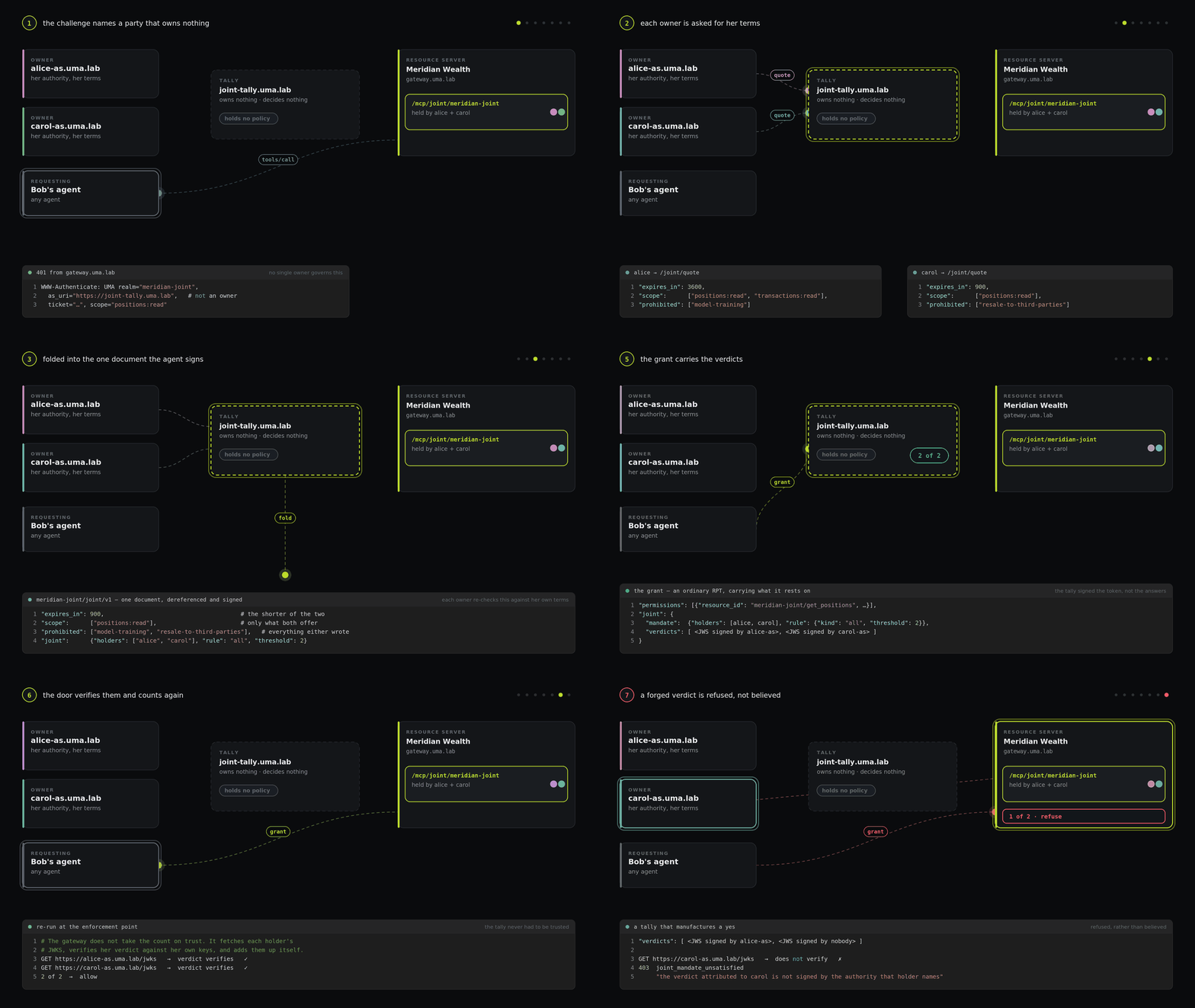
Three objects
mandate    who is entitled to be counted, at what weight, and how many it takes
verdict    one owner's authority, signing its answer to one negotiation
tally      the party that collects verdicts and does arithmetic
The third is the awkward one. Something has to put one question to several authorities and combine the answers, and whatever does that sits in a structurally privileged position — while every party here is a peer, so there is no principled place to put it.
The reflex is to make the privileged thing trustworthy: replicate it, distribute it, reach for a ledger. This takes the other route. The tally is made unable to lie, and then it does not matter who runs it.
Why this is not consensus
The word does real damage here. Distributed consensus solves agreement on an ordered history among parties who need a coordinator they cannot trust. None of that applies.
Verdicts about one negotiation are a set, not a sequence — nothing depends on which arrived first. There is no long-lived state to protect, because grants are short and re-negotiated; no balance exists that a fork could double-spend. Replay is prevented by binding each verdict to a negotiation and an exact agreement digest, which is a signature problem rather than a ledger one.
And the coordinator does not have to be trusted, so it does not have to be decentralised. You decentralise a coordinator when you are forced to trust one. Making it unable to fabricate a yes removes the requirement instead of satisfying it.
What is left is a fold and a comparison.
What the tally cannot do
It cannot manufacture a yes. It holds no key that any relying party accepts as a verdict. The grant it issues carries the owners' signed verdicts inside it, and the enforcement point verifies each against the keys that owner's authority publishes, then re-runs the count. A tally that forged a verdict, replayed an old one, or reported a threshold it never reached is refused at the door.
The count runs against the mandate the tally publishes, never the copy inside the grant. Otherwise the party being checked supplies the standard it is checked against — one genuine verdict beside a mandate saying one is enough would pass, with every signature verifying.
Reading it from the tally is safe for two reasons. Each owner's verdict names the digest of the mandate she agreed to, so a published mandate with a weight moved has a different digest, and no verdict was given under it. And which authority speaks for each owner is the enforcement point's own configuration — the same table it uses to send her own requests to her authority — not whatever the mandate says. A tally that invented an owner, named an authority it runs, and signed that owner's verdict itself would have every signature verify; it is refused because the resource server has never heard of that owner, or knows her by a different authority.
A verdict lasts as long as the agreement it is about, and the tally issues no grant that outlives the first verdict it carries. An honest grant is never refused for carrying an answer that lapsed before the grant did.
It cannot put genuine verdicts behind a different grant. The enforcement point sees the grant and the verdicts, never the agreement, so a verdict that said only "yes" would fit inside any grant. An allow verdict therefore states what that owner's authority verified: the key that signed, the scopes and lifetime agreed, and the one operation if there was one. A grant bound to another key, or wider, or longer, or no longer bound to that operation, is refused.
It cannot weaken anybody's terms. It folds every owner's terms into the one document an agent signs, and each owner's authority independently compares what was signed against what she published — refusing on any difference in the direction of more.
It decides nothing about identity. It checks that the agreement was signed by the key it names, because that key is bound into the grant, and stops. Whether the agent is identified, who operates it, and whether that operator published the key are judgements the owners' authorities make with their own evidence. A coordinator that graded identity would be a coordinator holding policy.
One document, everybody's terms
An agent cannot usefully sign four documents, and an intersection computed by the requesting side is one computed by the party that benefits from computing it generously. So the agent is offered a single folded document:
| expiry | the shortest any owner set |
| scopes | only those every owner offers |
| prohibitions | every one any owner wrote |
| asks a person | if any owner wants asking |
That is the same operation as a firm applying a ceiling, pointed sideways instead of down — so it is the same code, with the one-directional guarantee already proved for the organization's envelope. What makes it safe to let an untrusted party do the folding is that it is checked afterwards by everyone it could have cheated.
Why a verdict is not a claim the agent gathers
The obvious UMA-shaped answer is claims-gathering: need_info names what is
required, the requesting party collects it and returns. That machinery is old
and rich — the UMA1-era claim-profiles work imagined need_info carrying a
great deal of structure, which is also where this profile's terms template
comes from.
It is still the wrong home for a verdict, because a claim the client gathers is a claim the client can decline to gather.
An agent holding two allows and one refusal has every incentive to present the two and report the third as outstanding — and a claim that is missing looks exactly like one not yet answered. The refusal would never arrive. So verdicts travel authority-to-authority and the requesting party never handles one. It does end up carrying them, inside the grant, but by then the count is settled and the enforcement point re-checks it anyway.
The general rule is worth stating: claims work when the requesting party is the only one who has the fact, and fail when the fact might be adverse to it.
No organization reaches it
An owner can be two things at once: a member of an organization, and a co-owner of something with somebody else. Those are different relationships with different people, and the second is not the first's business.
A resource covered by a mandate is outside every organization's reach at her authority, whatever that organization's charter claims. She cannot enrol, on her own, something that is half his — her co-owner never saw that charter, never agreed to it, and cannot leave it.
A charter may only claim a namespace it names: northwind-vault/* is a
claim, */get_positions is refused. A wildcard where the namespace goes
reads as "this kind of resource, wherever it lives", which is exactly the
reach an organization must not have — it matches a member's own brokerage
account and an account she holds with a stranger.
That stops the accident. The deliberate case is refused at her authority instead, which is where a co-owner's safety has to live: an administrator cannot see a request waiting on her about the joint account, cannot answer one, and the organization's ceiling does not touch the terms she writes over it.
The protection runs one way. A mandate's resources are matched as patterns,
so meridian-joint/* excludes everything under it — but a mandate cannot take
out what her organization itself claims. Her authority refuses to agree to one
over the firm's own resources, and ignores one when deciding what the firm
may reach, so a member cannot lift the firm's ceiling off its own book by
joining a mandate anyone could publish.
One consequence is visible to her: terms over a jointly held resource cannot share a tier with anything else. They are half somebody else's, and a mixed tier would be the way round all of the above.
Silence is not consent
An owner who has written no terms over the resource quotes nothing and is left out of the fold rather than defaulted into anything. Under a rule that needs everybody, that stops the request. An authority that cannot be reached is not a yes either. Both fail closed, and only the logging tells them apart.
Who sets the threshold
"rule": { "kind": "all" }
"rule": { "kind": "any" }
"rule": { "kind": "threshold", "threshold": 3 }
Owners may carry different weights, and any means the lightest of them can
act alone — otherwise the word would quietly exclude somebody. A refusal does
not wait for everybody: the moment the outstanding weight cannot carry the
request over the threshold, it is refused.
A group cannot answer what quorum sets the quorum. So a mandate carries a floor supplied by somebody other than the holders — an account agreement, or a regulator — and a mandate below it is refused when it is loaded. That is the same shape as a firm's ceiling, which means peers compose horizontally while an authority above them clamps vertically. The two arrangements are orthogonal rather than rival.
What the agent sees
Nothing unusual. An ordinary challenge, an ordinary need_info with terms to
sign, an ordinary wait while people are asked. The as_uri happens to name a
party that owns nothing, and the terms document says so — who the holders are,
what the rule is, and how many it takes.
An unmodified agent negotiates with a tally exactly as it negotiates with an authorization server. A shape that required the requesting side to know about joint ownership would not be adoptable.
Run it
make joint-check37 assertions across six processes. The sharpest is the forgery: a grant with one verdict replaced by a signature nobody's authority made, refused at the enforcement point rather than believed.