Wire the owner's approval path
Holding a negotiation while a human decides, showing her something she can act on, and authorizing her without inventing a credential for her.
Waits for Alice
First contact pends whatever the tier. Her policy might permit this call, but she has no standing relationship with this agent yet, and approving one is how the relationship starts.
open tierticket.awaiting_owner · kind=connection
An owner-authoritative design is only as good as the moment the owner is asked. If that path is slow, confusing, or absent, every deployment quietly moves to a policy that never pends — and you have rebuilt the system you were replacing.
This guide covers the pend, the interface, and the credential that authorizes her.
Prerequisites
- An authority that can hold a negotiation across restarts
- A way to reach the owner — a portal, an app, a notification channel
- An identity provider the owner already authenticates against
1. Decide what pends
Two rules earn their place.
First contact pends, whatever the tier. An agent with no standing relationship gets a decision from the owner even for something her policy would otherwise permit. This is the day-one handshake, and it is what stops a permissive tier from being a permissive tier for everyone.
Ask-me tiers pend per operation. Once a connection stands, ordinary tiers grant automatically for that agent. Tiers the owner marked ask-me pend every time, with the specific operation attached.
Everything else grants without bothering her. An approval path that asks about everything trains the owner to approve without reading, which is worse than not asking.
2. Hold the negotiation, do not hold the call
When a request pends, the authority holds the rotated ticket and refuses with a "submitted" status. The agent re-presents after an interval, and while she decides each poll hands back the same ticket, so a reply lost on the way costs the agent nothing. The ticket is spent when there is an outcome.
On the agent's side, the pend is a state to render, not a call to hold open. An agent that can express waiting to its own user should hand the wait up rather than block on a socket for however long the owner takes to wake up.
If your agent speaks MCP, the 2026-07-28 revision turns this into a suspended, resumable call with a request-state handle instead of a held one. The owner's decision is still the owner's; the agent's client just stops hanging on it.
There is a gap here worth knowing about. The typed shapes available for "something is needed" all address the client's own user, so there is no field that says the wait is on a different person entirely. Today the subject travels as prose in the message. Until that changes, expect a conforming client to try satisfying the wait from its own user unless you say plainly that it cannot.
3. Show her something she can decide
The pending item has to carry enough for a decision and little enough to read on a phone:
- Which agent, by the label she gave it — not a key thumbprint
- What is being asked, in the resource's own vocabulary
- The exact operation, for an ask-me tier, with the parameters spelled out
- The terms the agent signed, dereferenceable rather than summarized
- Whether this is first contact or an established connection
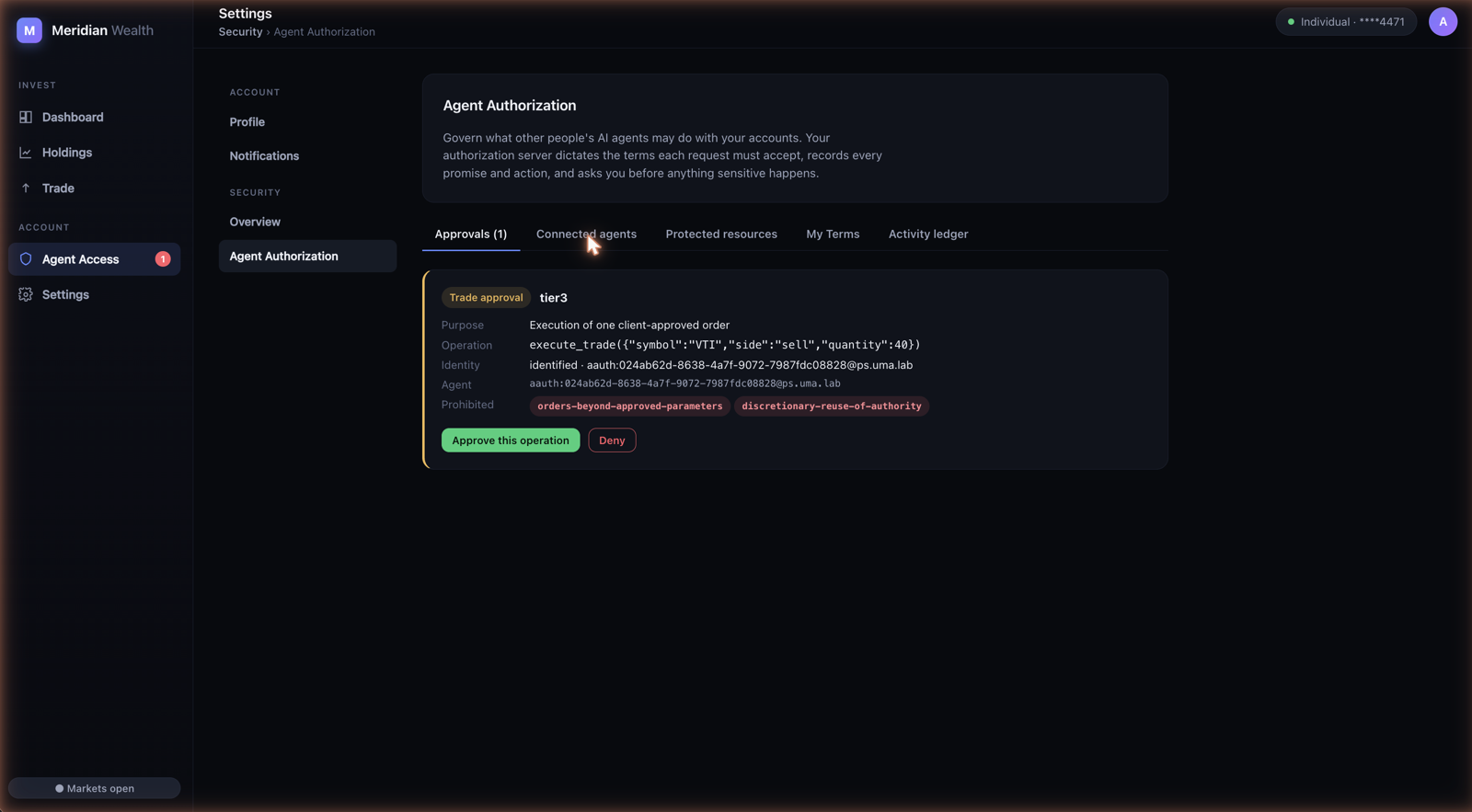
For an operation approval, the parameters she sees are the ones hashed into the
grant. If the display and the hash can disagree, the display is decoration. In
the shot above, the execute_trade arguments she is reading are the same bytes
the grant will bind to.
A live feed beats polling. In the lab it is a server-sent event stream, backed by the database's own notification mechanism, so a pod that restarts does not lose a request she has not answered.
4. Authorize her without inventing a credential
The owner API takes a credential that is hers — and there is more than one kind. An access token from the identity provider she already uses, validated against her realm's published keys, is the obvious one. A key her device holds, signing each request under RFC 9421, is the other; it is what lets her authority run somewhere that has no identity provider at all. See put the authority on her device.
Accept both where both make sense. A person reaches her own things from a browser, a phone and possibly a personal AI, and each credential should be independently sufficient and independently revocable.
No static owner credential exists anywhere in the system. This matters more than it sounds: a shared secret for the owner API is a permanent skeleton key for every decision the design exists to protect, and it will end up in an environment variable in a repository.
Validate the token properly: signature against published keys, issuer, expiry,
that it was issued to a client you run for her, and that it identifies the owner
whose resources are being decided on. The reference checks the client in azp,
because an access token's aud names what it may be sent to rather than who
obtained it, and identifies her by preferred_username, the identifier her
realm and her authority share.
5. Handle the decisions
Approve, on a connection request, records the standing relationship and issues the grant. Approve on an operation request issues an operation-bound grant for that operation only.
Deny ends the negotiation with a refusal the agent can distinguish from an error.
Two clocks run, and they belong to different parties. The negotiation's
lifetime is her authority's: a pend it has not heard her answer within
(UMA_AS_PENDING_TTL, an hour by default) expires, and the agent's next poll
gets an invalid-grant response; it can start again later. How long the agent
keeps polling is the agent's own choice. The lab's driver waits fifteen minutes
(UMA4A_OWNER_WAIT_S) and then gives up with grant denied: timed out waiting
for the owner — while the request is still waiting for her at her authority.
Either ending is correct behaviour rather than a failure.
6. Give her the undo
Approval without revocation is a one-way door. She needs, at minimum:
- Connections — the standing relationships, with revoke. Revoking marks every live grant behind that connection consumed, so introspection fails immediately rather than at the next expiry.
- Resource servers — which servers hold protection access, with revoke. Cutting one off kills its ability to register permissions and to verify tokens at the same time.
- Policy — her tiers, and which ones are ask-me, editable by her.
- The ledger — what was promised, what she personally approved, and what was actually touched, correlated.
Those three columns are the ones that answer the question she will actually ask: did what happened match what I agreed to.
Verify it
- A pending item survives the authority instance that created it being deleted
- A pending item survives a database failover, and she can still answer it
- A request expires cleanly and the agent is told why
- Revoking a connection kills its live grants immediately, not at expiry
- The owner API refuses a token that identifies somebody else
- The parameters she approved hash to the value the grant carries
Troubleshooting
Pending items vanish on deploy. They are in memory. Move them to the store.
She approves and nothing happens. The held ticket is on a different instance than the one that took her decision. The hold has to be in shared state, not in a process.
The event stream reconnects constantly. A proxy is timing out idle connections. Send periodic keepalives, or accept the reconnects and make them cheap.
Nobody uses the ask-me tier in real deployments. The path is too slow or the items are unreadable. That is a product problem and it will decide whether any of this gets adopted.